
A European 3PL operator recently retrofitted a 12,000 m² distribution center with UFO LED high bay lights — replacing 400W metal halide fixtures. The result: a 68% reduction in energy consumption and payback period of under 26 months. But the facility manager’s first question during sourcing was not about price. It was: “Should we use UFO or linear?”
It is one of the most common — and most consequential — decisions in industrial lighting procurement. Getting it wrong means under-lit picking aisles, glare complaints from forklift operators, or fixtures that physically do not fit the racking system. This guide provides a practical, specification-driven framework for making that call.
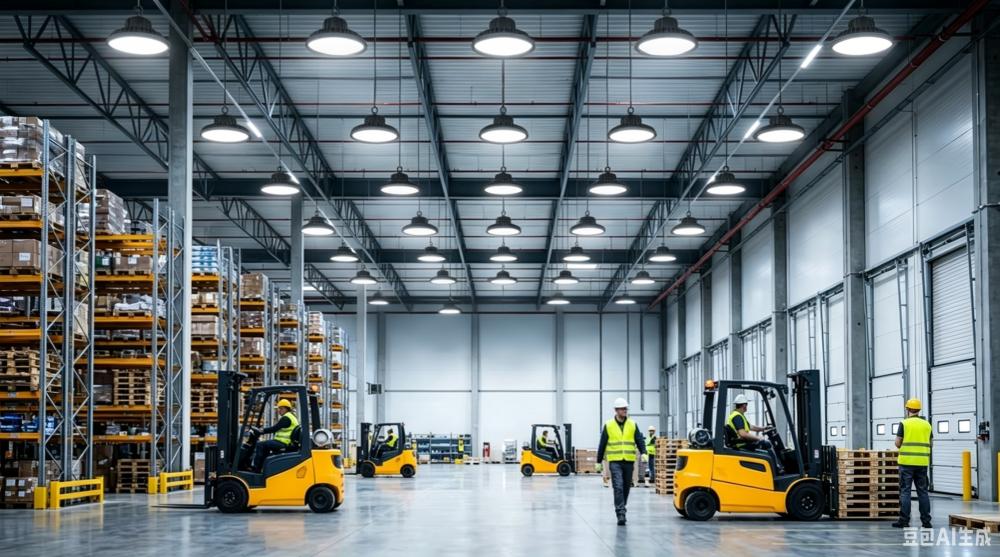
Key Differences: Geometry, Optics, and Application Fit
The choice between UFO (round) and linear high bay fixtures is fundamentally about light distribution geometry relative to your facility’s interior architecture.
Mounting Height and Beam Angle
| Specification | UFO High Bay | Linear High Bay |
| Optimal mounting height | 4–12m | 6–20m |
| Typical beam angle | 60°–120° symmetric | 60°–90° asymmetric or narrow |
| Light distribution | Omnidirectional (360° circular) | Rectangular, row-optimized |
| Best application | Open-plan warehouses, factories | Racking aisles, assembly lines |
| DIALux simulation | Simple (point source) | Requires row spacing optimization |
A UFO fixture like the AGUB17 (60W–200W) delivers a symmetric 120° beam that suits open manufacturing floors, aircraft hangars, and sports halls — any space where uniform illumination across a large area is the primary goal.
Linear high bays, by contrast, concentrate light in a narrow rectangular pattern ideal for 10-foot-wide racking aisles in high-bay storage (8m+ ceiling height). If your facility has dense racking, linear is almost always the correct choice despite the higher unit cost.
Power and Efficacy Range
AllGreen’s AGUB17 UFO series spans 60W to 200W, with three-way adjustability across:
● Power: field-adjustable without rewiring
● CCT (Color Temperature): 3000K–6500K switch for task-specific environments
● Beam Angle: interchangeable reflectors for 60°, 90°, or 120°
Installation and Maintenance Cost Analysis
Total Cost of Ownership: A 5-Year Model
Procurement decisions made on unit price alone routinely underestimate the true cost differential. Consider a 1,000 m² warehouse bay at 8m ceiling height:
| Cost Element | UFO LED (200W) | Metal Halide (400W) | HPS (250W) |
| Annual energy (8 hrs/day) | USD 584 | USD 1,168 | USD 730 |
| Lamp replacement (5 yrs) | USD 0 | USD 480 | USD 320 |
| Maintenance labor (5 yrs) | USD 200 | USD 900 | USD 600 |
| 5-Year Total per fixture | USD 3,920 | USD 7,348 | USD 5,250 |
Based on USD 0.10/kWh commercial rate, 8 operating hours/day, 365 days
The LED UFO fixture delivers 47% lower 5-year TCO versus metal halide, even before accounting for productivity gains from better color rendering (CRI ≥80 optional).
IP Rating Requirements by Application Zone
● Dry storage / manufacturing: IP54 minimum
● Cold chain / food processing: IP65 (dust-tight, low-pressure water jet)
● Outdoor loading docks / car parks: IP66 (dust-tight, high-pressure jet)
AllGreen’s AGUB17 is rated IP65, making it suitable for food processing facilities and cold storage environments where daily washdowns are standard practice.
Certification and Compliance for Industrial Buyers
| Standard | Relevance | AllGreen Coverage |
| IEC 60598-1 | General luminaire safety | Yes (CB scheme) |
| EN 60598-2-22 | Emergency luminaire requirements | Separate product line |
| UL 1598 | North America industrial | Available on request |
| DALI 2 / 0-10V dimming | Smart building integration | Standard on AGUB17 |
| IK08 impact resistance | Factory / logistics environments | Standard |
DALI 2 dimming compatibility is increasingly required in European industrial fit-outs for Building Management System (BMS) integration — a specification point that eliminates most commodity high bay suppliers in competitive tender situations.
Post time: Jun-18-2026