
For years, energy efficiency has been one of the main drivers behind the transition to LED street lighting.
And it has made a real difference.
Lower energy consumption, longer service life and reduced maintenance have helped cities improve public lighting while controlling operating costs.
But as LED becomes the standard, a new question is emerging:
What comes after energy efficiency?
Today, having a high lm/W rating is important — but it is no longer the whole story.
From Efficient Products to Efficient Systems
Two street lights can have similar power consumption and luminous efficacy, yet deliver very different results.
Why?
Because effective public lighting depends on more than the LED source.
It also depends on:
- Optical distribution
- Lighting uniformity
- Glare control
- Pole spacing and mounting height
- Operating schedules
- Maintenance requirements
- Control systems
In other words:
Luminaire efficiency ≠ System efficiency.
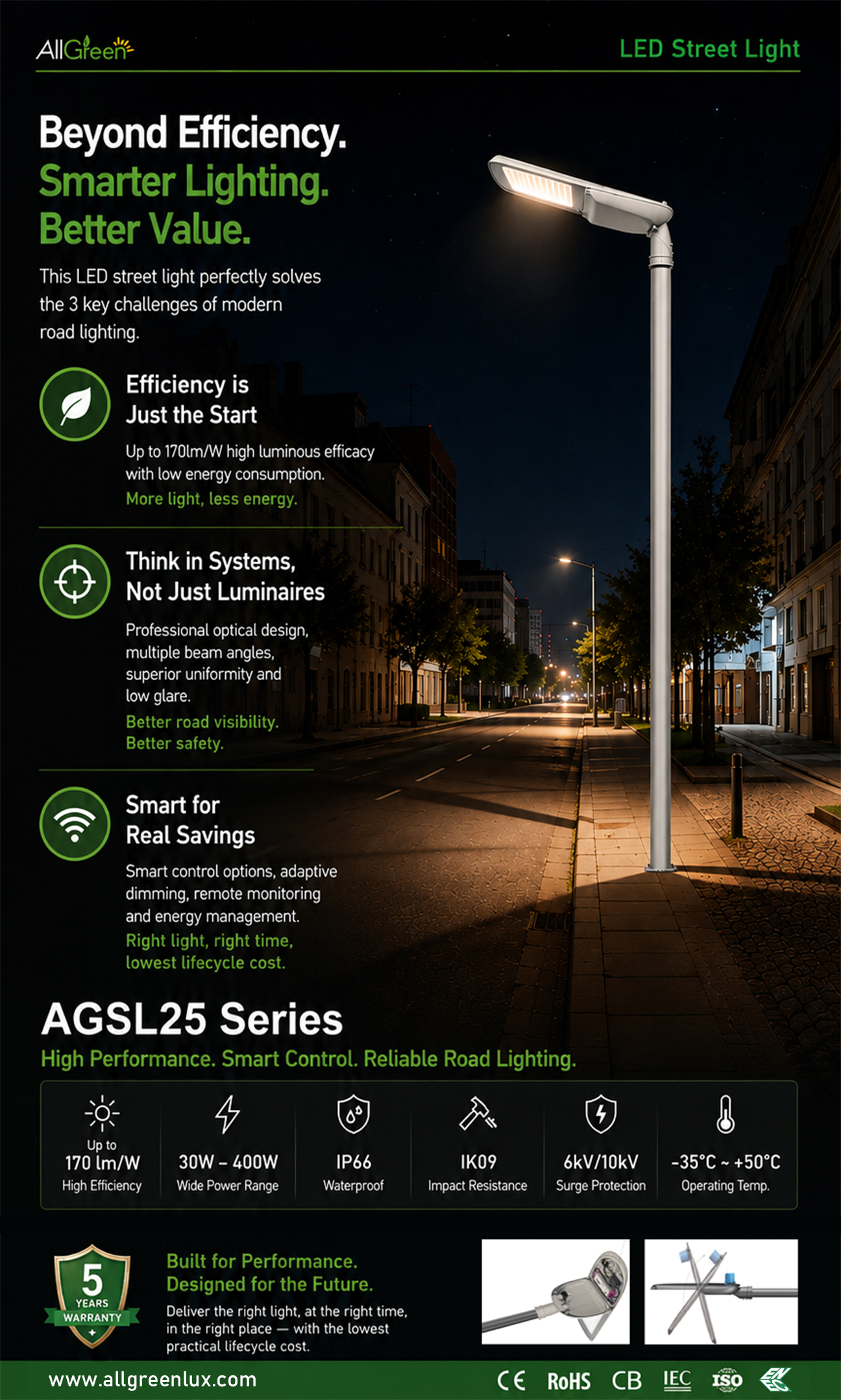
The real question is not simply how much light a luminaire produces, but how efficiently the lighting system delivers useful light where it is needed.
The Next Opportunity: Smarter Operation
Energy savings can also come from using light more intelligently.
Traffic and pedestrian activity change throughout the night. In suitable applications, adaptive lighting and scheduled dimming can reduce unnecessary energy consumption while maintaining appropriate lighting levels.
Smart lighting, however, should not mean adding technology for its own sake.
Remote monitoring, dimming, fault detection and energy management are valuable when they solve real operational problems.
Smart does not mean more technology. It means better control and better decisions.
Look Beyond the Purchase Price
For public infrastructure, the initial product price is only part of the equation.
Reliability, maintenance, spare parts, serviceability and lifetime energy consumption can have a significant impact on the total cost of ownership.
This is why modern street lighting should be evaluated across its entire lifecycle — not only by wattage or purchase price.
The Bigger Picture
The next generation of public lighting is likely to move from:
Energy Efficiency → Optical Performance → Smart Operation → Lifecycle Value
Energy efficiency will remain the foundation.
But perhaps it is no longer the destination.
The goal is not simply to use less energy.
It is to deliver the right amount of light, in the right place, at the right time — with the lowest practical lifecycle cost.
What do you think?
For modern public lighting projects, which factor will matter most in the coming years?
Energy efficiency, smart control, reliability, optical performance, or total cost of ownership?
Post time: Aug-31-2026