
When designing an LED luminaire, engineers usually focus on power, luminous efficiency, optical distribution, IP rating, and control systems.
But there is another decision that can have a significant impact on the final product:
How should the luminaire housing and structural components be manufactured?
Four processes are widely used in LED lighting manufacturing: die casting, aluminum extrusion, sheet metal fabrication, and injection molding.
Each has different strengths. The right choice depends on the product’s geometry, thermal requirements, production volume, application environment, and cost.
1. Die Casting: For Complex Aluminum Housings
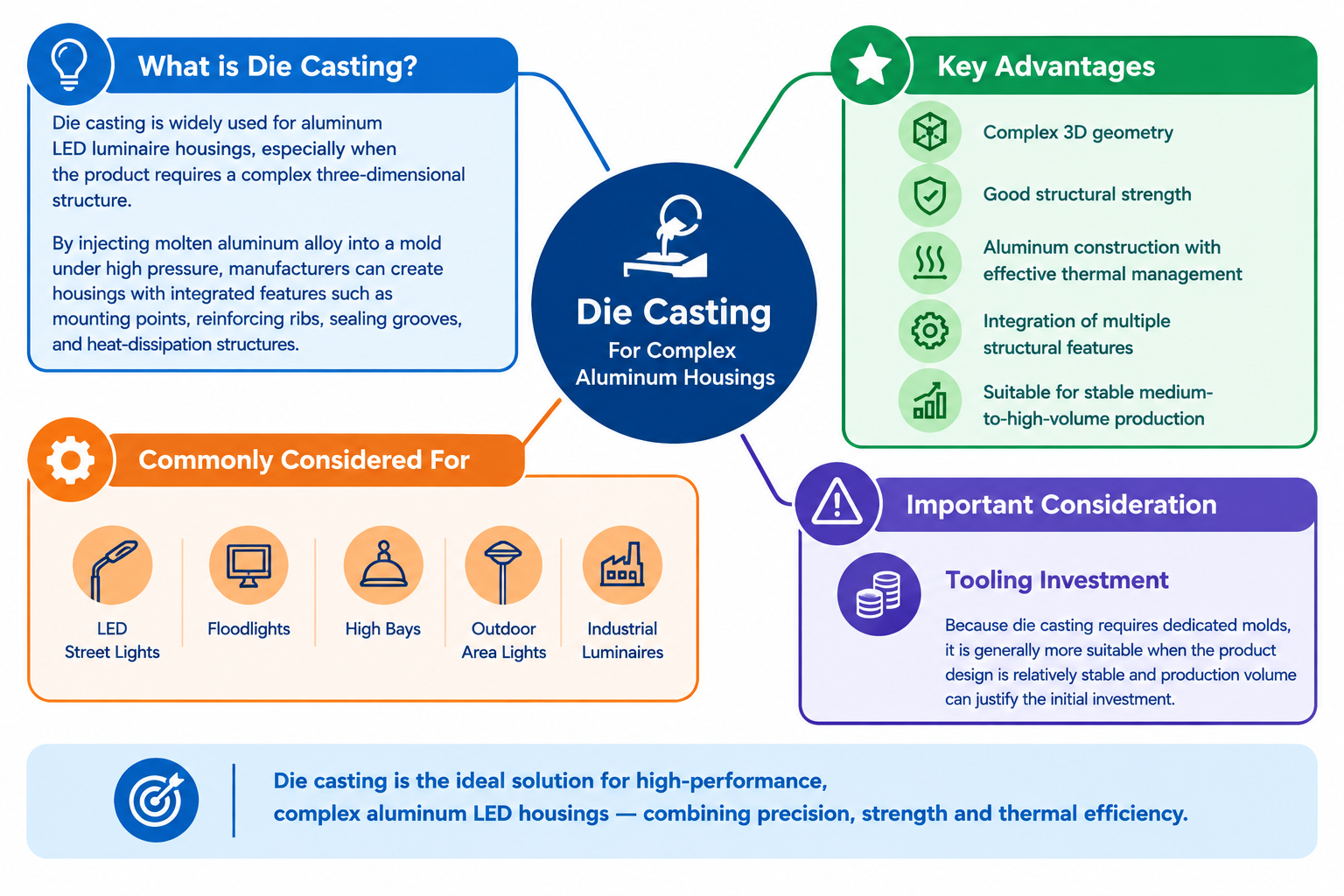
Die casting is widely used for aluminum LED luminaire housings, especially when the product requires a complex three-dimensional structure.
By injecting molten aluminum alloy into a mold under high pressure, manufacturers can create housings with integrated features such as mounting points, reinforcing ribs, sealing grooves, and heat-dissipation structures.
Key Advantages
- Complex 3D geometry
- Good structural strength
- Aluminum construction with effective thermal management
- Integration of multiple structural features
- Suitable for stable medium- to high-volume production
Die casting is commonly considered for:
LED Street Lights · Floodlights · High Bays · Outdoor Area Lights · Industrial Luminaires
The main consideration is tooling investment. Because die casting requires dedicated molds, it is generally more suitable when the product design is relatively stable and production volume can justify the initial investment.
2. Aluminum Extrusion: For Linear and Continuous Structures
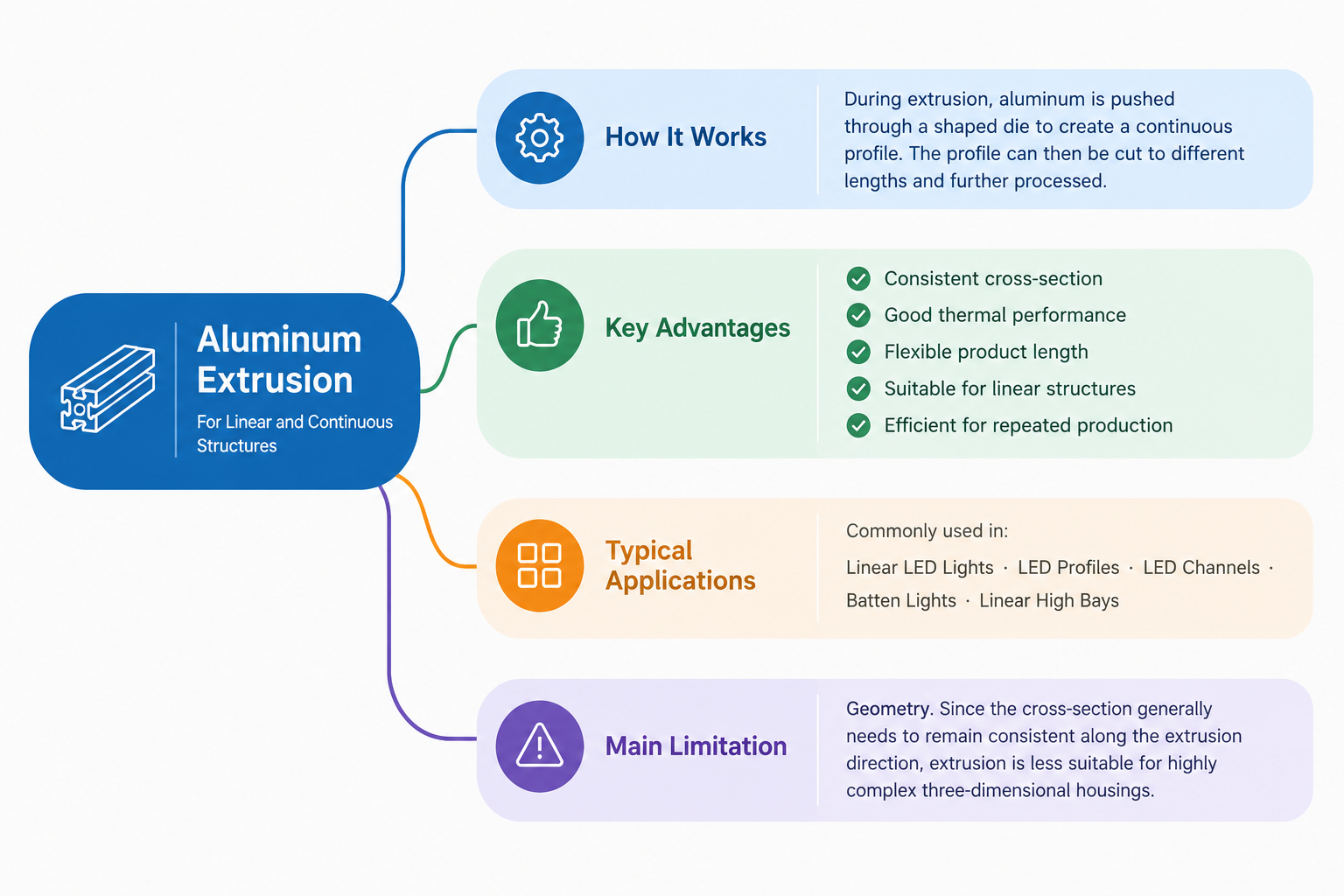
Aluminum extrusion is particularly suitable for products with a long, consistent cross-section.
During extrusion, aluminum is pushed through a shaped die to create a continuous profile. The profile can then be cut to different lengths and further processed.
Key Advantages
- Consistent cross-section
- Good thermal performance
- Flexible product length
- Suitable for linear structures
- Efficient for repeated production
Typical applications include:
Linear LED Lights · LED Profiles · LED Channels · Batten Lights · Linear High Bays
The main limitation is geometry. Since the cross-section generally needs to remain consistent along the extrusion direction, extrusion is less suitable for highly complex three-dimensional housings.
3. Sheet Metal: Flexible for Structural Components
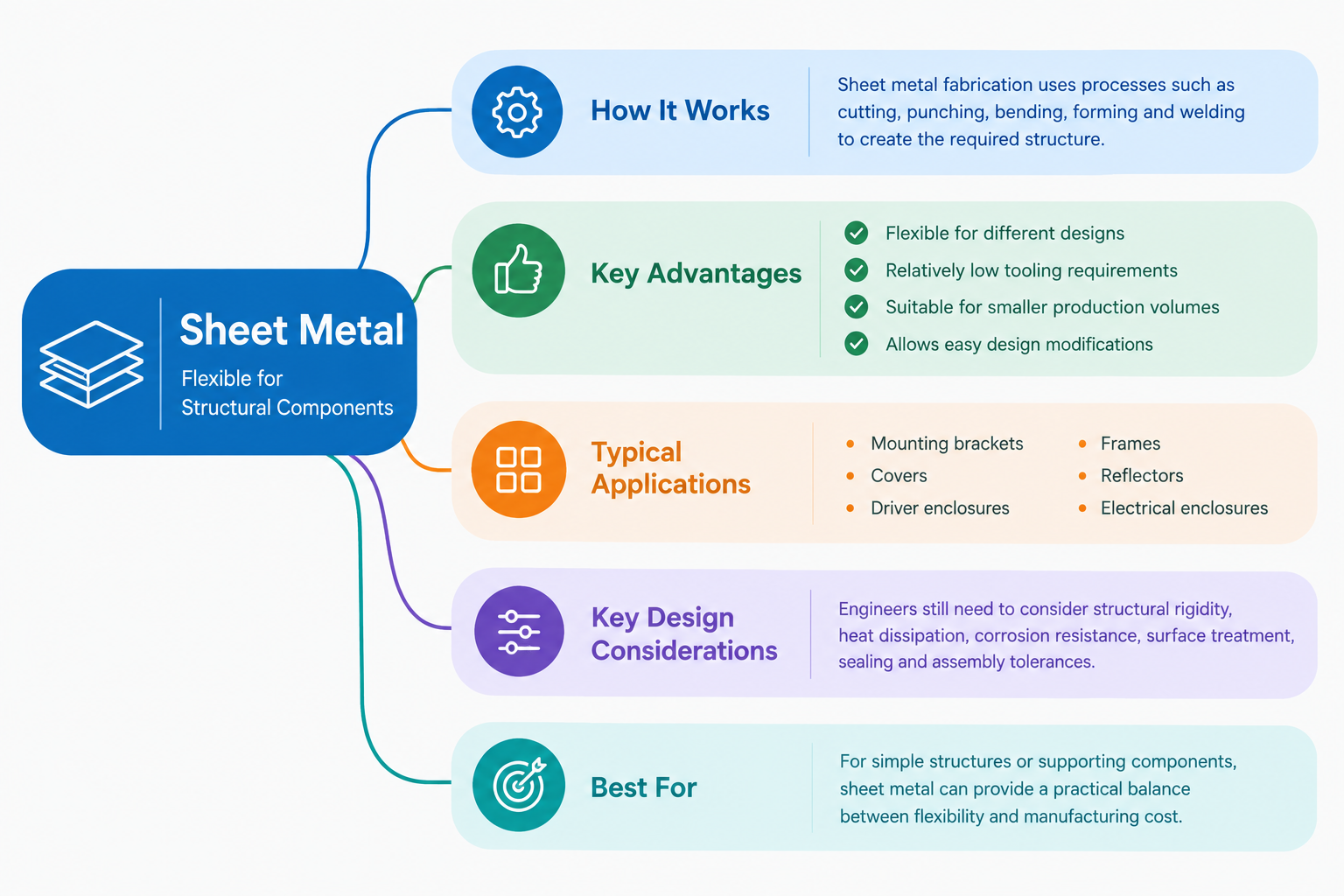
Sheet metal fabrication uses processes such as cutting, punching, bending, forming, and welding to create the required structure.
It can be a practical option when flexibility, relatively low tooling requirements, or smaller production volumes are important.
Typical Applications
- Mounting brackets
- Covers
- Driver enclosures
- Frames
- Reflectors
- Electrical enclosures
Sheet metal also allows relatively easy design modifications during product development.
However, engineers still need to consider structural rigidity, heat dissipation, corrosion resistance, surface treatment, sealing, and assembly tolerances.
For simple structures or supporting components, sheet metal can provide a practical balance between flexibility and manufacturing cost.
4. Injection Molding: For Plastic and Optical Components
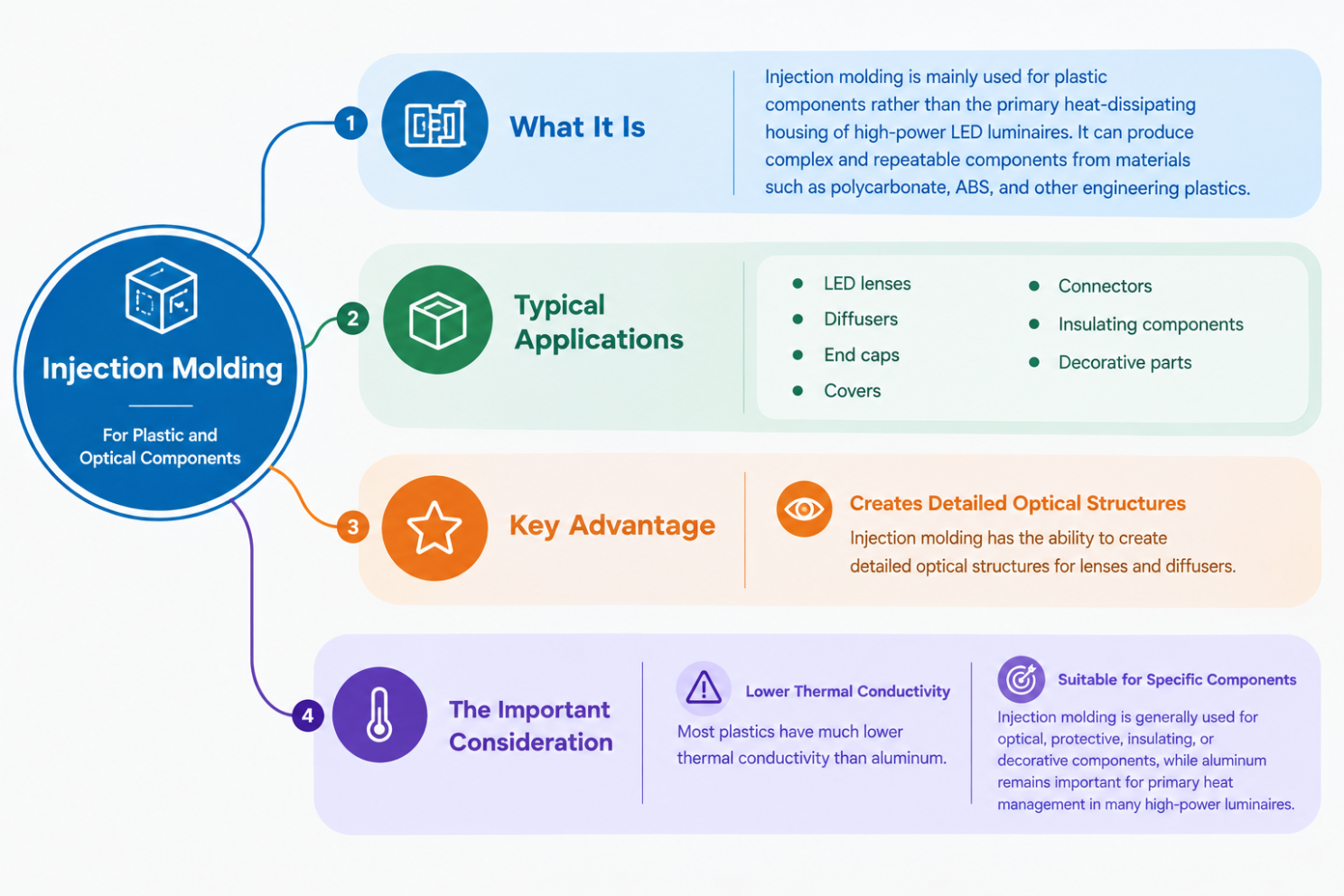
Injection molding is mainly used for plastic components rather than the primary heat-dissipating housing of high-power LED luminaires.
It can produce complex and repeatable components from materials such as polycarbonate, ABS, and other engineering plastics.
Typical applications include:
- LED lenses
- Diffusers
- End caps
- Covers
- Connectors
- Insulating components
- Decorative parts
One important advantage is its ability to create detailed optical structures for lenses and diffusers.
However, most plastics have much lower thermal conductivity than aluminum. Therefore, injection molding is generally used for optical, protective, insulating, or decorative components, while aluminum remains important for primary heat management in many high-power luminaires.
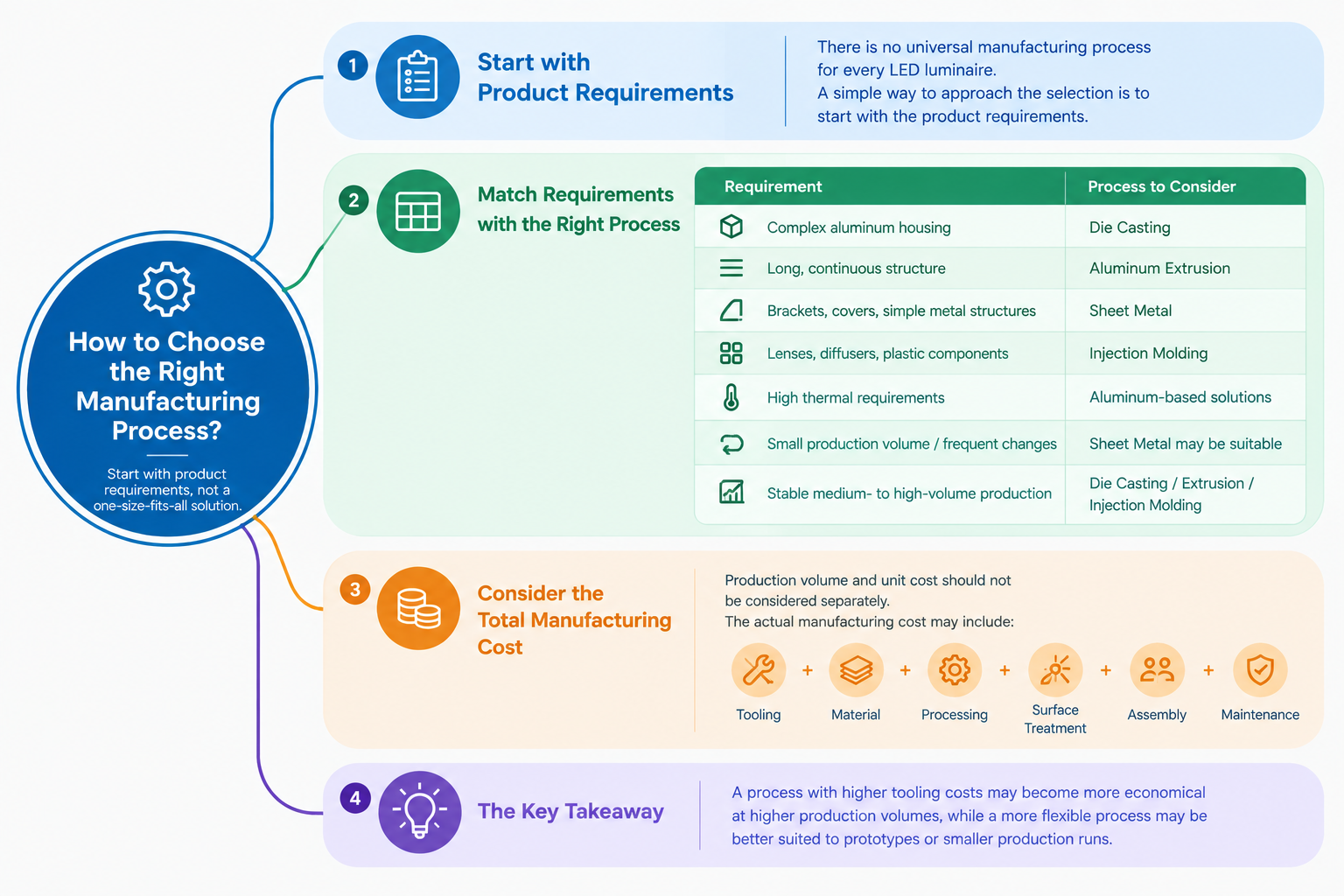
5. How to Choose the Right Manufacturing Process?
There is no universal manufacturing process for every LED luminaire.
A simple way to approach the selection is to start with the product requirements.
| Requirement | Process to Consider |
| Complex aluminum housing | Die Casting |
| Long, continuous structure | Aluminum Extrusion |
| Brackets, covers, simple metal structures | Sheet Metal |
| Lenses, diffusers, plastic components | Injection Molding |
| High thermal requirements | Aluminum-based solutions |
| Small production volume / frequent changes | Sheet Metal may be suitable |
| Stable medium- to high-volume production | Die Casting / Extrusion / Injection Molding |
However, production volume and unit cost should not be considered separately.
The actual manufacturing cost may include:
Tooling + Material + Processing + Surface Treatment + Assembly + Maintenance
A process with higher tooling costs may become more economical at higher production volumes, while a more flexible process may be better suited to prototypes or smaller production runs.
6. One Luminaire Can Use Multiple Manufacturing Processes
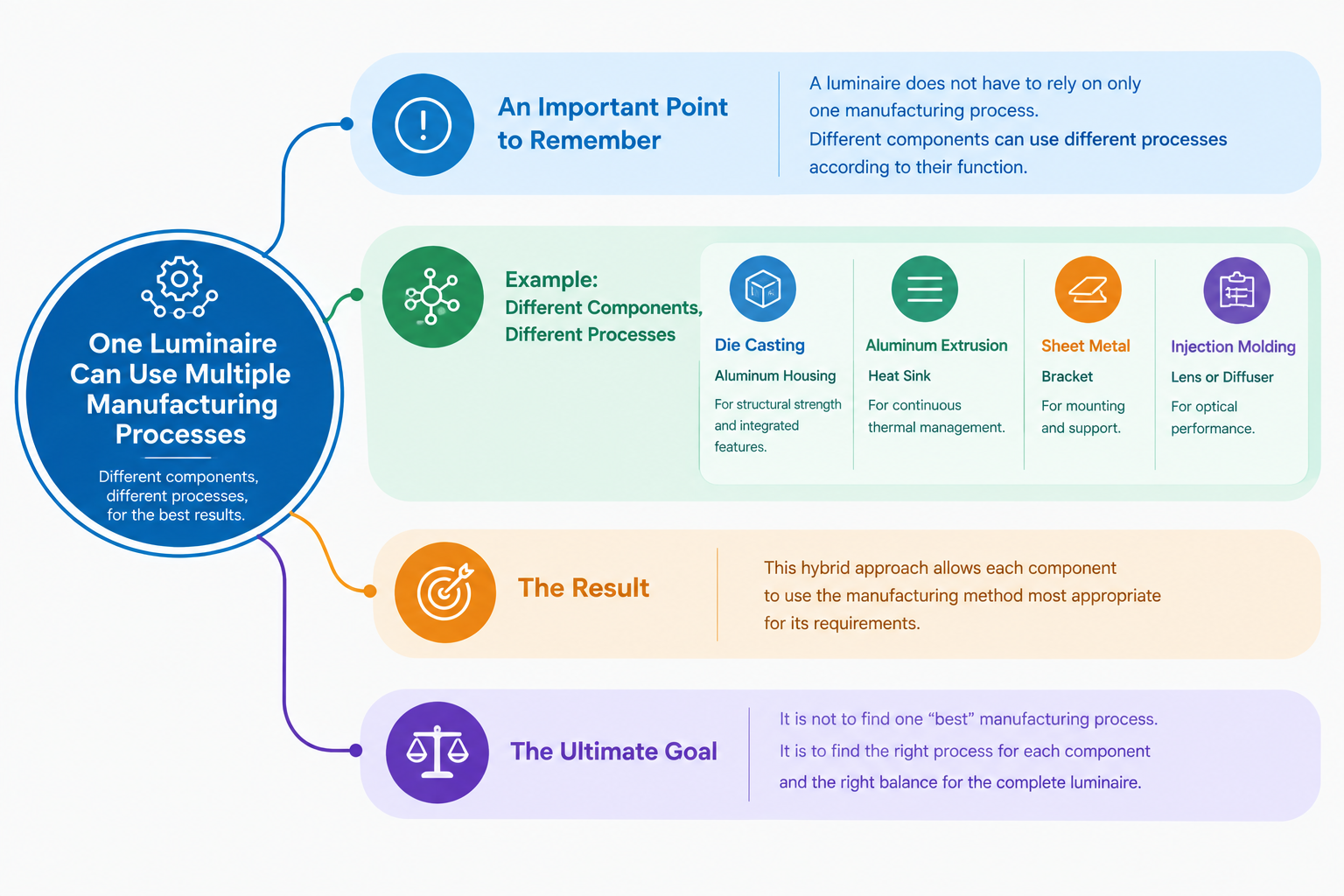
One important point is often overlooked:
A luminaire does not have to rely on only one manufacturing process.
Different components can use different processes according to their function.
For example:
Die-cast aluminum housing
for structural strength and integrated features
Extruded aluminum heat sink
for continuous thermal management
Sheet metal bracket
for mounting and support
Injection-molded lens or diffuser
for optical performance
This hybrid approach allows each component to use the manufacturing method most appropriate for its requirements.
Ultimately, the goal is not to find one “best” manufacturing process.
It is to find the right process for each component and the right balance for the complete luminaire.
Conclusion
The manufacturing process behind an LED luminaire can influence its thermal performance, structural strength, appearance, production efficiency, cost, and maintenance.
Die casting is well suited to complex aluminum housings.
Aluminum extrusion works particularly well for long and linear structures.
Sheet metal provides flexibility for brackets, covers, and other structural components.
Injection molding is suitable for plastic, optical, insulating, and decorative parts.
The final choice should be based on the complete product requirements—not simply the lowest manufacturing cost.
At AllGreen, product development considers luminaire structure, thermal management, application conditions, manufacturing requirements, and maintenance together, helping provide professional lighting solutions and customized one-stop services for different project applications.
The right manufacturing process is not simply the one that costs less. It is the one that fits the product.
Post time: Sep-10-2026